
What Is Vaporwave?
Vaporwave is the ghost of a future that never arrived. This piece explores the genre’s evolution from a niche audio experiment to a philosophical critique of capitalism and memory.
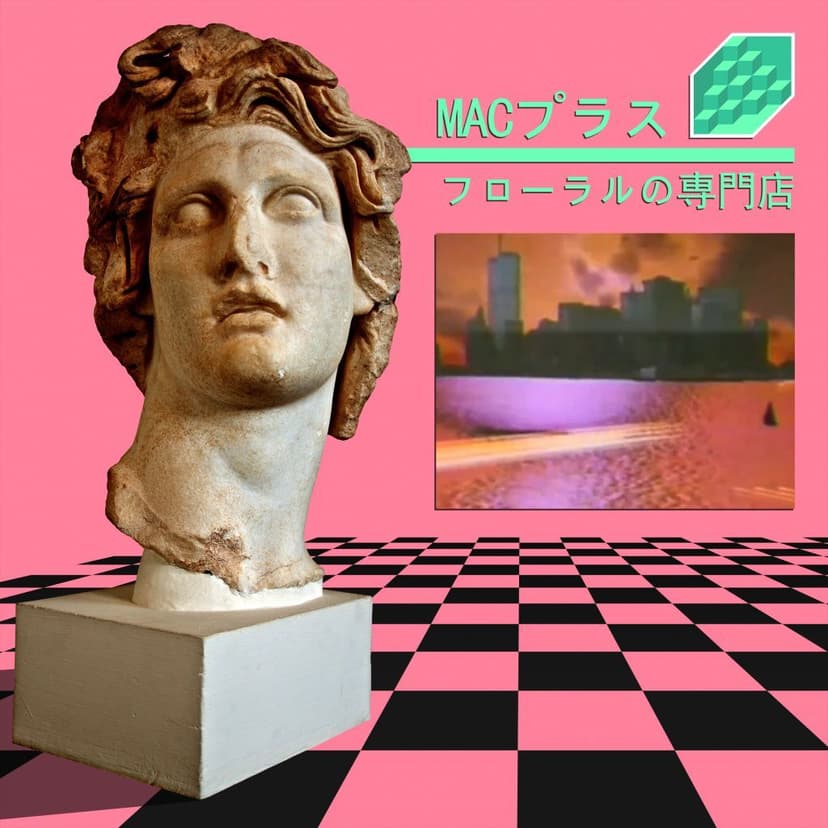
Floral Shoppe - The Most Rapresentative Vaporwave Album
Vaporwave: Ontology of a Lost Future and the Matrix of Contemporary Digital Aesthetics
Vaporwave emerges in the early 2010s as a transmedia phenomenon that merges music, digital imagery, and socio-economic critique. Borrowed from the tech term vaporware—products announced but never released—it evokes the idea of a suspended future, a promise without materialisation. Vaporwave embodies this condition: it aestheticises the nostalgia for imagined futures produced by the consumer culture of the 1980s and ’90s, futures that never came to pass.
Through slowed-down samples of Muzak, smooth jazz, city pop, and corporate jingles, vaporwave turns capitalist optimism into melancholy. Sounds engineered to soothe and motivate become unnervingly introspective. Visually, the genre constructs a digital museum of distorted memories: classical statues, Windows 95 interfaces, neon sunsets, and low-poly landscapes coalesce into a dreamlike archive of global consumer culture.
The Technical Genealogy: From “Chopped & Screwed” to Digital Hauntology
A crucial technique behind vaporwave is extreme temporal manipulation, derived from DJ Screw’s “chopped and screwed” style. Applied not to rap but to corporate and commercial music, this slowing-down process reveals the hidden eeriness of familiar cultural products. Cheerful melodies stretch into lamentations; human voices become spectral; time itself is suspended.
Vaporwave also inherits sensibilities from chillwave and hypnagogic pop—genres driven by lo-fi nostalgia for VHS aesthetics and childhood memories. But vaporwave embodies the darker counterpart: if chillwave evokes a sun-drenched afternoon in 1985, vaporwave evokes wandering alone through an empty shopping mall.
Foundational Works: Three Architectural Pillars of Vaporwave
Three albums define its sonic and conceptual DNA:
Eccojams Vol. 1 (2010) by Daniel Lopatin introduces looping as existential erosion—fragments of ’80s pop repeated until meaning dissolves.
Far Side Virtual (2011) by James Ferraro constructs not a past but a synthetic present made of system sounds, menu music, and digital notifications—a sonic portrait of information-age banality.
Floral Shoppe (2011) by Macintosh Plus establishes the iconic vaporwave sound: pop slowed to delirium, voices rendered post-human, and a cover that fuses classical sculpture, Japanese script, pre-9/11 skylines, and digital grids.
Together, these works do not simply create a genre; they articulate a new way of experiencing time, nostalgia, and memory.
Vaporwave as Philosophy: Hauntology, Desire, and the Failure of the Future
Vaporwave is a philosophical object as much as an aesthetic one. It resonates with Mark Fisher’s concept of hauntology: the idea that the 21st century is haunted by futures that never happened. Contemporary culture, unable to imagine alternatives, endlessly recycles its past.
Vaporwave is not nostalgic for the real 1980s; it mourns the futures the 1980s imagined. Futures of prosperity, technological optimism, and stability—visions promised by late capitalism but subsequently betrayed.
Its political ambiguity is essential. Vaporwave:
- critiques consumerism by exposing its emptiness,
- yet fetishises corporate logos, advertising, and digital debris.
It is an aesthetic of contradiction: we long for what alienates us; we critique what we cannot let go of.

The Vaporwave Aesthetic: A Museum of Digital Memory
Vaporwave’s visual world is an archeology of digital consciousness:
- Classical statues reduced to glitchy digital ornaments, signalling the commodification of cultural heritage.
- Interface nostalgia for Windows 95, Netscape, and early operating systems—interfaces from a time when technology felt “innocent,” even hopeful.
- Techno-orientalism, using Japanese text and anime imagery as symbols of a once-imagined techno-utopia.
- Liminal spaces: hotel corridors, empty malls, office atriums—non-places stripped of human presence, transformed into psychological landscapes of alienation.
These aesthetics do not merely portray spaces; they portray states of mind.
How Vaporwave Changed the Internet and Reshaped Global Aesthetics
Vaporwave is one of the first fully post-Internet movements—not just distributed online, but conceptually inseparable from online culture. It taught a generation to treat the digital past as material for remix, critique, and emotional projection.
After vaporwave, the web began to see itself as:
- an archive of collective memory,
- a space where errors and glitches become meaningful,
- a playground where corporate visual languages can be deconstructed.
Its influence extends far beyond the genre itself.
Liminal Spaces derive directly from the vaporwave fascination with malls, airports, and empty transitional environments. They express collective digital anxieties: placelessness, temporal drift, and existential disorientation.
Analog Horror and Web Horror borrow vaporwave’s degraded VHS textures, broken broadcasts, and local-TV aesthetics to create uncanny narratives.
Frutiger Aero—the nostalgia for 2004–2013 (Windows Vista/7, iPhone 1, Wii, glossy skeuomorphism)—is a direct successor. Where vaporwave is nocturnal and critical, Frutiger Aero is bright, clean, and techno-optimistic. Yet it repeats the same mechanism:
turning past digital interfaces into emotional landscapes.
Y2K revival, post-skeuomorphic design, and corporate hell aesthetics all inherit vaporwave’s central idea:
the imagery of capitalism can be recontextualised into art, critique, or dreamlike memory.

Conclusion: Vaporwave as the Language of a Haunted Present
More than a decade after its emergence, vaporwave remains one of the defining aesthetics of the digital age. It articulates a collective feeling: the melancholy of futures that never arrived. It reshapes the web into an emotional archive. It teaches that technological pasts do not disappear—they echo.
And as culture shifts toward Frutiger Aero, Y2K, and early-smartphone nostalgia, the underlying impulse remains unchanged:
to search for a soul, however synthetic and fragmented, in a world made of copies, loops, and simulations.