
Millenium Bug : The Year the World Almost Reset
As the clock ticked toward midnight on December 31, 1999, the world wasn't just preparing for a party—it was preparing for a digital collapse. The Millennium Bug (Y2K) was the first true existential crisis of the Information Age, a "logical artifact" born from the frugality of 1960s programmers that threatened to paralyze global infrastructure.
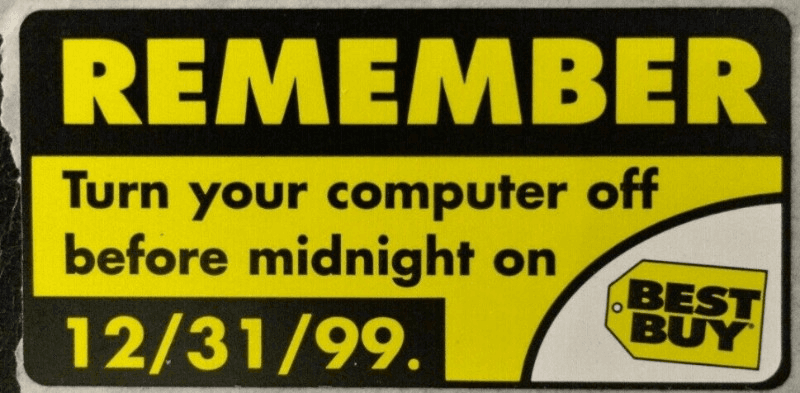
Best Buy remember tag
Imagine it is late 1999. The atmosphere is electric, almost messianic, but beneath the celebrations bubbles a collective anxiety unlike anything seen before. This wasn’t a physical threat, but a logical artifact: a silent ticking time bomb nestled within the invisible foundations of the world. This was the Millennium Bug (or Y2K)—the first true existential crisis of the Information Age.
Code Archaeology: A Billion-Dollar Glitch
It all began with a brutal economic necessity in the 1960s and 70s. Back then, computer memory was an extreme luxury; every single bit was precious. To save space, programmers decided to represent years using only two digits (e.g., "72" for "1972"). It was a rational choice at the time—no one imagined that this code, often written in COBOL, would still be running thirty years later.
The problem was as simple as it was devastating: at the stroke of midnight on December 31, 1999, computers would read "00." To a machine, "00" comes before "99." This arithmetic inversion threatened to send financial calculations, pension deadlines, and global security systems into a total tailspin, effectively resetting the world to 1900.
The Sociology of Panic: Between Bunkers and Prophecies
While technicians worked behind the scenes, the media transformed the bug into a pop culture phenomenon. Time magazine ran the headline "The End of the World?!", fueling catastrophic scenarios: planes falling from the sky, hospitals plunged into darkness, and nuclear reactors spiraling out of control.
This uncertainty triggered extreme societal responses:
- Survivalism: Many began stockpiling food and water, turning their suburban homes into bunkers.
- Bank Panics: Fear that ATMs would cease to function prompted the Federal Reserve to print an extra $50 billion in cash to ensure liquidity.
- Millenarianism: For various religious communities, the bug was a divine sign—the return of Christ or a digital punishment for humanity's technological hubris.
The Digital "New Deal": Who Saved the World?
The world didn’t collapse not because the danger was fake, but because of the largest maintenance operation in human history. Between $300 and $600 billion were spent to correct billions of lines of code.
This mobilization reshaped global geopolitics:
- The Rise of India: The need for a massive, cost-effective workforce led Western companies to outsource to Indian engineers, transforming India into the IT superpower it is today.
- The COBOL Cowboys: Retired programmers were called back into service with massive salaries to decipher archaic code that younger generations no longer understood.
The Transition Night: The Forgotten Glitches
On January 1, 2000, the lack of immediate explosions led many to dismiss the crisis as a "scam." In reality, glitches did occur, but they were contained by extreme surveillance:
- Nuclear Power: In Japan, monitoring systems at the Shika power plant went offline at midnight.
- Intelligence: The US experienced a three-day blackout in receiving data from spy satellites.
- Healthcare: In the UK and Sweden, age-calculation errors led to incorrect Down syndrome screening results for pregnant women.
- The Absurd: In Denmark and Germany, the first babies of the year were registered by hospital computers as 100-year-old centenarians born in 1900.
The Prevention Paradox and the Aesthetic Legacy
Today, we live with the "Prevention Paradox": if you spend billions to stop a bridge from collapsing and it stays standing, people will claim you wasted your money. The Millennium Bug was the first global civil maintenance event—a success so complete that it erased the traces of its own danger.
But the most fascinating legacy of Y2K today isn't technical; it’s cultural. It is remarkable how a logical error that terrified banks has become, twenty years later, a nostalgic atmosphere and a fashion statement.
Generation Z has transformed "Y2K" into an aesthetic of metallics, translucent plastics, and technological optimism. It’s a form of collective exorcism: we took the name of a crisis and turned it into the symbol of an era when the internet still felt magical and the future looked like a thrilling adventure—even if it risked breaking at midnight.
The monster was defeated so thoroughly that we now wear its name on our t-shirts, forgetting that an anonymous army of programmers saved the world, one line of code at a time.
New Horizons of Risk
The Millennium Bug was only the first round. On the horizon, new challenges await:
- The Year 2038: When 32-bit systems will run out of space to count seconds and reset to 1901.
- Y2Q: The threat of quantum computers against the encryption that currently protects all global data.